Ford introduced EcoBoost technology in 2009 and has continued refining the idea ever since. What started with a twin-turbocharged 3.5L V6 eventually spread into Ford trucks, SUVs, smaller three- and four-cylinder engines, and performance vehicles such as the Mustang EcoBoost and F-150 Raptor.
Today, EcoBoost refers to Ford gasoline engines that combine turbocharging, direct fuel injection, and variable camshaft timing. Those technologies work together to help relatively compact engines produce strong horsepower and torque while keeping efficiency in mind.
For shoppers, the important part isn't memorizing how every component works. It's understanding what EcoBoost can mean behind the wheel: responsive acceleration, useful low-end torque, available towing capability, and a surprisingly broad range of choices from the compact Bronco Sport to the full-size F-150 and Expedition.
How Does Ford EcoBoost Work?
EcoBoost gets its performance from three technologies working together.
Turbocharging: A turbocharger uses energy from the engine's exhaust to compress incoming air and push more of it into the engine. More air helps the engine make more power when you need it, such as merging onto a freeway, passing another vehicle, climbing a grade, or towing.
Direct fuel injection: Fuel is delivered precisely into the combustion chamber, allowing the engine to control how much fuel is used while still producing strong power.
Variable camshaft timing: The engine continuously adjusts when its intake and exhaust valves open and close. Under acceleration, those adjustments can support greater torque and power; during lighter-load cruising, they can help reduce fuel consumption.
Put simply, EcoBoost lets Ford get more useful performance from a smaller-displacement engine than you might expect just by looking at the engine size.
What Are the Benefits of a Ford EcoBoost Engine?
For most shoppers, EcoBoost's advantages show up in everyday driving rather than on a specification sheet.
- Strong low-end torque can make a truck or SUV feel responsive without having to rev the engine aggressively.
- Quick acceleration is useful for entering DFW-area freeways, passing, or getting up to speed with traffic.
- Compact engines can still make substantial power.
- Some EcoBoost models offer strong EPA-estimated fuel economy, particularly when you don't need a large truck or SUV.
- The technology works across very different vehicles, from daily drivers and family SUVs to tow vehicles and off-road models.
- You can choose the amount of capability you actually need rather than automatically stepping up to the largest engine available.
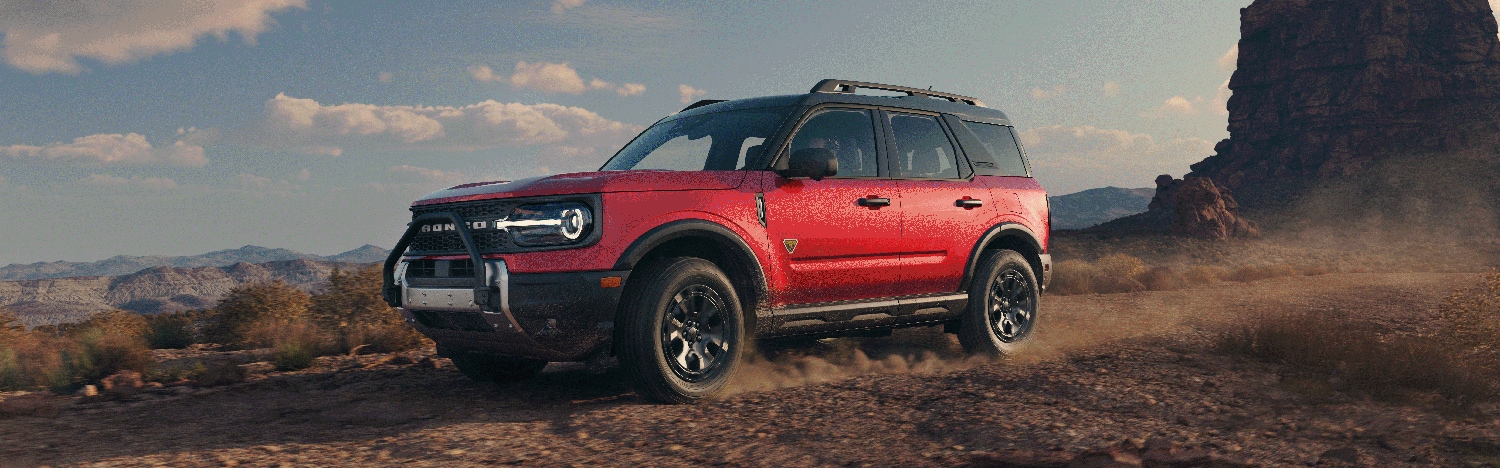
The 2026 Bronco Sport shows that range well. Its 1.5L EcoBoost produces 180 horsepower and 200 lb.-ft of torque while earning an EPA-estimated 25 city/30 highway MPG with standard 4x4. The available 2.0L EcoBoost raises output to 250 horsepower and 280 lb.-ft of torque.
At the performance end, the 2026 Mustang EcoBoost uses a 2.3L engine producing 315 horsepower and 350 lb.-ft of torque on 93-octane fuel. Ford lists EPA-estimated fuel economy of 22 city/33 highway MPG for current 2026 EcoBoost Fastback inventory.
EcoBoost also scales well into trucks. The 2026 Ranger's available 2.7L EcoBoost develops 315 horsepower and 400 lb.-ft of torque, while properly configured Ranger XL, XLT, and Lariat models can tow up to 7,500 pounds.
For full-size truck shoppers, the 2026 F-150's 2.7L EcoBoost produces 325 horsepower and 400 lb.-ft of torque, while the 3.5L EcoBoost produces up to 400 horsepower and 500 lb.-ft of torque. Ford lists a maximum available tow rating of 13,500 pounds with the 3.5L EcoBoost when properly configured.
Which Current Ford Models Offer EcoBoost Engines?
Engine availability can depend on trim, drivetrain, configuration, and model year.
|
Ford Model |
EcoBoost Engine Option(s) |
|
1.5L EcoBoost, 2.0L EcoBoost |
|
|
2.3L EcoBoost I-4, 2.7L EcoBoost V6, 3.0L EcoBoost V6 |
|
|
2.3L EcoBoost I-4, 3.0L EcoBoost V6 |
|
|
3.5L EcoBoost V6 |
|
|
Available 2.0L EcoBoost |
|
|
2.3L EcoBoost, 2.7L EcoBoost V6, 3.0L EcoBoost V6 |
|
|
2.7L EcoBoost V6, 3.5L EcoBoost V6, High-Output 3.5L EcoBoost V6 |
|
|
2.3L EcoBoost |
Ford has released the 2027 Explorer, and the same basic EcoBoost choice continues: a 2.3L EcoBoost I-4 is offered across much of the lineup, while the 3.0L EcoBoost V6 is available on Tremor and Platinum and standard on ST.
Which EcoBoost-Powered Ford Fits the Way You Drive?
Choosing becomes easier once you start with what you'll actually ask the vehicle to do most often.
|
If You Prioritize... |
Ford Models to Consider |
|
Daily commuting and maneuverability |
Bronco Sport, Maverick, Mustang EcoBoost |
|
Compact pickup versatility |
Maverick |
|
Off-road driving and outdoor recreation |
Bronco, Bronco Sport |
|
Three-row family space |
Explorer |
|
Full-size SUV space and towing |
Expedition |
|
Midsize pickup capability |
Ranger |
|
Towing and full-size truck versatility |
F-150 |
|
Sporty performance |
Mustang EcoBoost |
EcoBoost Makes Sense for the Way Irving and DFW Drivers Actually Drive
Irving sits in the middle of one of the most highway-intensive parts of North Texas. SH-183 runs through central Irving, SH-114 connects the area with I-35E and northwest Fort Worth, I-635 crosses the city's northern edge, and Loop 12 and the President George Bush Turnpike connect drivers with the rest of the Metroplex.
That means plenty of local drivers split their time between stop-and-go traffic, frontage roads, short errands, and stretches of higher-speed freeway driving.
For a weekday commute involving SH-183, SH-114, or I-635, the Bronco Sport offers manageable dimensions while still giving you turbocharged power when traffic opens up. The 1.5L model's EPA-estimated 25 city/30 highway MPG also makes it an appealing option for drivers who spend more time commuting than towing.
The Maverick makes sense if you want a pickup bed without driving a full-size truck every day. Ford's available 2.0L EcoBoost produces 250 horsepower and 280 lb.-ft of torque, giving the Maverick noticeably more muscle while retaining its compact-truck footprint.
If your routine includes hauling a trailer, heading out of town on weekends, or simply needing more truck capability, the Ranger and F-150 give you progressively greater towing and power options.
Families who spend a lot of time crossing the Metroplex may be better served by the three-row Explorer, while an Expedition adds full-size passenger and cargo space along with serious towing capability. The 2026 Expedition's 3.5L EcoBoost produces 400 horsepower and 480 lb.-ft of torque, with up to 9,600 pounds of conventional towing capacity when properly equipped.
And if practicality isn't the only item on the shopping list, the Mustang EcoBoost gives you turbocharged performance in a package that's still perfectly capable of handling the daily run through Irving or Dallas.
Westway Ford's current new-vehicle inventory reflects that range, with Bronco, Bronco Sport, Explorer, Expedition, Maverick, Ranger, F-150, and Mustang models represented across its Ford lineup.
Does EcoBoost Require Premium Fuel?
Not every EcoBoost engine requires premium fuel for normal driving.
Fuel recommendations vary by engine. For example, Ford lists regular unleaded as the minimum fuel for both 2026 Bronco Sport engines, although premium is recommended for the 2.0L. Ford also notes that its published Bronco Sport horsepower and torque ratings are based on premium fuel.
The Ranger provides another useful example: Ford recommends 87 octane for its 2.3L and 2.7L EcoBoost engines, while the Ranger Raptor's 3.0L EcoBoost calls for 91 octane.
For a specific vehicle, check Ford's fuel recommendation and the Owner's Manual, particularly if maximum advertised performance matters to you.
Find the Right EcoBoost-Powered Ford at Westway Ford
EcoBoost gives Ford shoppers a lot of room to choose. You can prioritize commuting efficiency, pickup versatility, family space, off-road capability, towing, or performance without giving up the responsive torque that makes turbocharged engines appealing in the first place.
Browse Westway Ford's current new Ford inventory online, or visit Westway Ford at 801 W Airport Fwy in Irving, TX 75062. The team can help you compare models, trims, EcoBoost engines, towing capability, and features based on how you'll actually use your next Ford.